Emergency Lighting Compliance: BS 5266 in Plain English
The British Standard that keeps your building legal, and your occupants safe when the power fails.
7 min read
UK guide · London & Essex focus
BS 5266 is the rulebook for emergency lighting in the UK. It tells you where lights must go, how bright they need to be, how often you test them, and what records you keep. If you’re responsible for a commercial building, a block of flats, or anywhere the public can walk into, you’re expected to follow it. The Fire Safety Order doesn’t give you a checklist, it just says you must provide adequate emergency escape lighting. BS 5266 fills in the blanks.
Most building owners only hear about this standard when a fire-risk assessor flags non-compliance or an insurer asks for test certificates. By then you’re playing catch-up. This guide unpacks the key requirements so you know what’s expected before someone else tells you.
What BS 5266 Actually Covers
BS 5266 is split into parts. Part 1 (Code of Practice) is the one that matters for day-to-day compliance. It sets out design, installation, testing and maintenance. Part 7 covers high-risk task area lighting, think industrial kitchens or plant rooms where people need to see detail to shut something down safely. Part 8 is about signs (exit, fire-exit, directional). You’ll often see BS 5266-1:2016 and BS EN 1838 referenced together; the European standard defines the photometric performance, the British standard tells you how to apply it.
The standard assumes you’ve already done a fire-risk assessment under the Regulatory Reform (Fire Safety) Order 2005. That assessment identifies escape routes, final exits, and any areas where people might be in the dark if mains power fails. BS 5266 then tells you how to light those routes and what equipment to use.
Minimum Illumination Levels and Duration
Emergency escape lighting must provide at least 1 lux along the centre line of every escape route. That’s enough to see obstacles, steps, and changes in direction. At high-risk points, open-area centres larger than 60 m², stairwells, changes of level, fire-fighting equipment, first-aid stations, you need higher levels or specific spot coverage.
The lights must stay on for a minimum of one hour after mains failure if the building is evacuated immediately. If people sleep on the premises (hotels, care homes, student halls), you need three hours duration. Non-maintained fittings (off in normal use, on during power cut) are common in offices and retail. Maintained fittings (always on, fed by battery backup) suit corridors and stairwells where you want constant illumination.
Colour rendering matters less than you’d think, the standard allows fairly poor colour discrimination because the priority is seeing shapes and exits, not reading fine print. But exit signs must be clearly visible from every point along the route, and directional arrows must point unambiguously toward the final exit.
Testing Frequency Under BS 5266
You can’t fit emergency lights and forget them. The standard mandates three levels of routine testing:
- Daily visual check: a quick walk-round to confirm indicator LEDs are showing green (battery charged, mains present). Takes five minutes.
- Monthly functional test: simulate mains failure for long enough to confirm each fitting illuminates. The standard says this can be brief, many modern self-test fittings do it automatically and log the result.
- Annual full-duration test: run every fitting on battery for the full rated duration (one or three hours depending on occupancy type). Measure light levels with a lux meter at critical points. Record any failures or dimming. Replace batteries or fittings that don’t meet the threshold.
All tests must be logged in a permanent record, a paper logbook or digital system. The Fire Safety Order requires you to keep these records indefinitely, or at least until the next full-duration test cycle. Inspectors and insurers will ask to see them.
Design and Spacing: Where Lights Must Go
You can’t just scatter a few bulkheads along the corridor and call it done. BS 5266-1 gives spacing rules based on mounting height and beam pattern. A typical non-directional fitting mounted at 2, 3 metres can cover about 15 metres of corridor, but that assumes no obstructions and a reasonably straight route. Corners, doorways, and intersections need their own fittings.
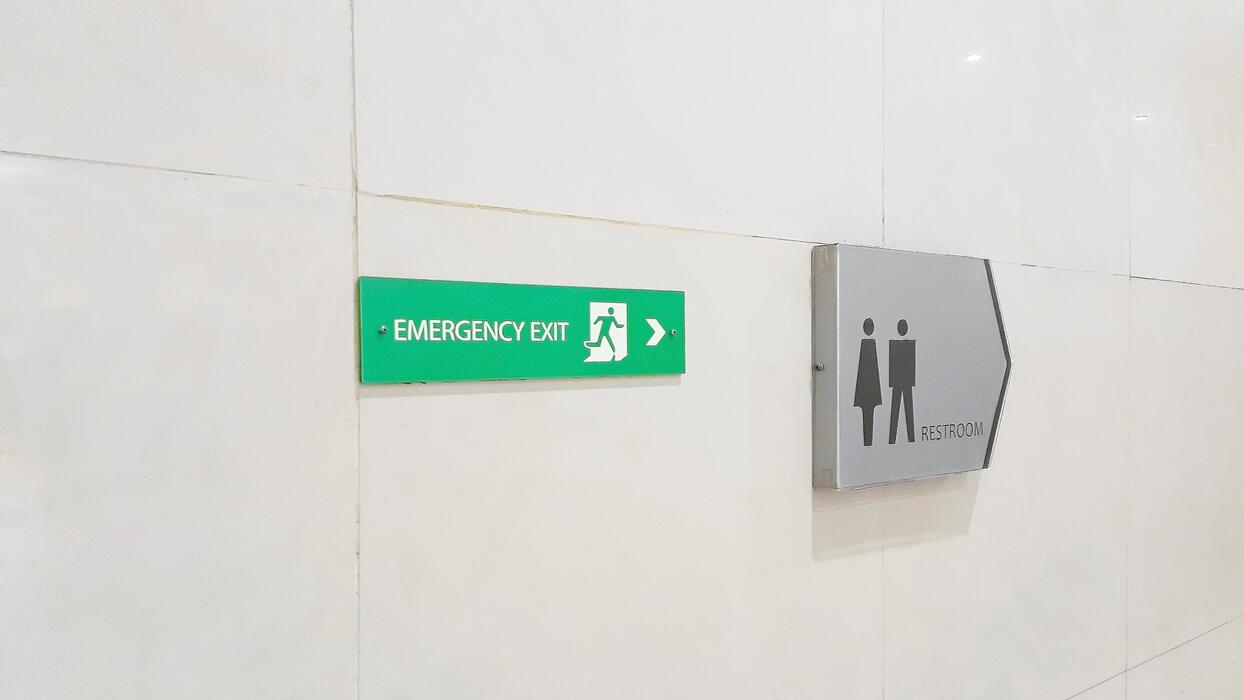
Every final exit and exit door along the route must be clearly marked with a BS EN 1838-compliant sign, green running man, white pictogram, specific luminance ratios. If the route turns or branches, you need directional arrows at each decision point. Open-plan areas over 60 m² need anti-panic lighting: enough fittings to ensure no part of the floor is more than twice the mounting height from the nearest luminaire.
Stairwells are high-risk. You need a fitting at each landing, positioned so every tread is visible. External escape routes, fire escapes, car parks, pathways to assembly points, also need emergency lighting if they’re part of the designated means of escape. That often gets missed.
Self-Test vs. Manual-Test Fittings
Modern self-test emergency lights run their own monthly and annual checks, log the results to internal memory, and flag faults via an indicator or central monitoring panel. They cost more up front but slash maintenance time. A 50-unit office that used to take half a day each month can now be checked remotely in minutes. Manual-test fittings are cheaper but require someone to walk the building with a test key, trigger each fitting, and write down the result. Both are compliant; the choice is cost versus labour.
Record-Keeping and Certification
The logbook is your proof of compliance. It must record every test, date, time, who did it, which fittings were tested, any defects found, and what action was taken. If a fitting fails the annual duration test and you replace the battery, log it. If you add new fittings after a fit-out, log the commissioning test.
When an electrician installs or modifies an emergency lighting system, you should receive a commissioning certificate showing that the installation meets BS 5266-1 and BS EN 1838. This isn’t the same as an Electrical Installation Certificate (which covers the mains wiring). The commissioning cert includes a lux-level survey, a schedule of fittings, battery types, and duration ratings. Keep it with the logbook.
Some local authorities and insurers want an annual third-party inspection on top of your in-house testing. That’s not strictly required by the standard, but it’s becoming common practice for higher-risk premises. The inspector will verify your test records, measure light levels, check battery condition, and issue a report. Budget around £200, £400 for a typical small commercial building, more for multi-floor or complex layouts.
Common Pitfalls and How to Avoid Them
Batteries left until they fail: NiCd and NiMH cells degrade after 3, 4 years; lithium can go longer but still needs monitoring. If you wait for the annual test to reveal a dead battery, you’ve been non-compliant for months. Replace batteries on a schedule, not on failure.
Inadequate coverage after a refit: you knock down a wall, move a partition, or install new racking. Suddenly the escape route has changed and the old fittings don’t cover it. Always review emergency lighting after any building work.
Missing external routes: the fire-risk assessment says people muster in the car park, but there’s no emergency lighting between the back door and the assembly point. If it’s dark and raining, that’s a hazard.
No logbook: tests done, nothing written down. In the eyes of an inspector, it didn’t happen. Even a basic paper logbook is better than memory.
Wrong duration: one-hour fittings in a care home that needs three. Check occupancy type and match the battery rating.
Who’s Responsible?
Under the Fire Safety Order, the responsible person, usually the building owner, landlord, or employer, must ensure emergency lighting is adequate and maintained. You can delegate the testing to a facilities manager or contractor, but legal liability stays with you. Make sure whoever does the work is competent and keeps proper records.
Retrofitting and Upgrades
Older buildings often have emergency lighting that was compliant when installed but no longer meets current standards. The 2016 revision of BS 5266-1 tightened some spacing rules and clarified sign requirements. You’re not automatically obliged to rip out a 2005 system, but if your fire-risk assessment identifies deficiencies, poor coverage, failed fittings, inadequate duration, you must remedy them.
LED emergency fittings have largely replaced fluorescent. They’re more efficient, longer-lasting, and easier to integrate with self-test electronics. Retrofitting is usually straightforward: new fittings on the same circuit, commission, test, log. Budget £80, £150 per non-maintained LED bulkhead, more for maintained or addressable units. A typical 1,000 m² office might need 20, 30 fittings depending on layout.
Addressable systems, where every fitting reports status to a central panel, suit larger or multi-tenanted buildings. You get real-time fault alerts, automated test scheduling, and compliance reports at the press of a button. Initial cost is higher, but ongoing labour drops significantly.
BS 5266 and Other Standards
Emergency lighting doesn’t sit in isolation. You’ll also encounter:
- BS EN 50172: European standard for emergency-lighting systems, covering similar ground to BS 5266 but with a different structure. UK practice tends to reference both.
- BS 5839 (fire detection and alarm): your fire alarm and emergency lighting often share cable routes and need coordinated testing.
- Building Regulations Approved Document B: sets out means-of-escape requirements; emergency lighting is part of that picture.
- The Equality Act 2010: accessible means of escape must be adequately lit, including refuge points and accessible WCs.
A competent installer will cross-reference all relevant standards during design. If someone quotes you for emergency lighting without mentioning BS 5266, ask why.
Bottom Line
BS 5266 isn’t optional and it isn’t vague. It gives you clear numbers, 1 lux minimum, one or three hours duration, monthly and annual tests, and clear responsibilities. Get the design right at installation, keep the batteries fresh, log every test, and you’ll sail through inspections. Ignore it and you’re gambling with lives and liability. Most non-compliance we see comes from neglect, not ignorance: batteries that died two years ago, logbooks that stop in 2019, fittings added in a refit but never commissioned. Fix those gaps and you’re 90 per cent of the way there.
Need help with this in London or Essex?
Stern MEB is an OZEV-approved, NICEIC-certified electrical contractor based in Woodford Green. We cover home, workplace and commercial electrical work across London and Essex.
Need Emergency Lighting Installed, Tested or Brought Up to Standard?
Stern MEB designs, installs and maintains BS 5266-compliant emergency lighting across London and Essex, call us for a site survey and fixed quote.
- Free site survey
- Fixed-price quote
- NICEIC certificate
- 12-month warranty
Book a free site survey
London & Essex · same working day response